Day 3 · Design, group inference, and ICA in practice

Day 3Session 3.1Wager1:30 hLecture

Experimental design: psychological and statistical principles

This lecture covers how to design an fMRI task so that participants actually engage the psychological process of interest and so that the resulting brain signals can be detected efficiently. It works through five psychological considerations, the algebra of design efficiency, and eight statistical principles of fMRI design, ending with computer-aided design optimization.

Take-aways

  • A design must first induce the intended mental process; activation for the wrong reasons is easy to obtain.
  • Efficiency is set by predictor variance and covariance, and can be computed from the design before any data are collected.
  • Number of subjects, block length near 18 s, randomization and event spacing of several seconds matter more than clever modeling.

Key terms

  • design efficiency
  • A-optimality
  • predictor variance
  • high-pass filter
  • autocorrelation matrix
  • block design
  • event-related design
  • jitter and catch trials
  • BOLD nonlinearity
  • genetic algorithm optimization
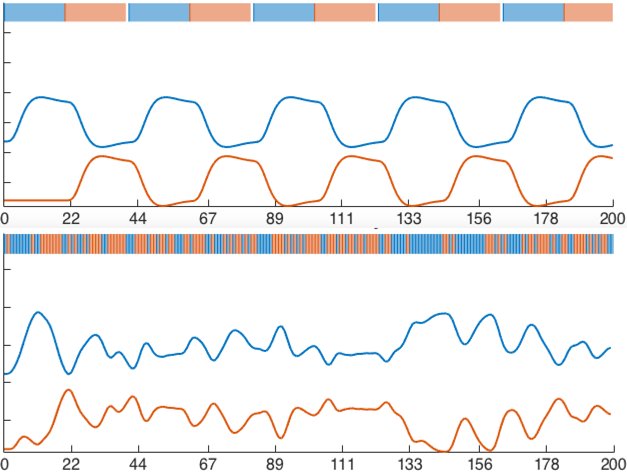
Predicted BOLD responses for block versus event-related designs
Predicted BOLD responses for block versus event-related designs. Lecture 3.1 slides (Wager)

Outline

What the session covers

01Bird's-eye view: two kinds of considerations

  • The goal is to induce the psychological state you are studying and detect brain signals related to it.
  • You control what is presented and when; design choices have both psychological and statistical consequences.
  • Psychological question: does the task make subjects think the way you intend?
  • Statistical question: does the timing of events give enough power to estimate the effects you care about?
02Five psychological considerations

  • Stimulus predictability changes the process: in a go/no-go task, predictable no-go stimuli allow preparation, unpredictable ones demand inhibition on each trial.
  • Time on task: you can only image what subjects are doing; famous-face recognition takes ~250 ms, leaving seconds for off-task thought unless presentation is rapid.
  • Participant strategy: in the Stroop task, predictable compatible trials induce reading rather than color naming, confounding control with task.
  • Temporal precision: expectations must fit what subjects can do; people cannot switch sad and happy recall in a typical block design.
  • Unintended activity: subjects spontaneously shift attention between trials, so the modeled sequence (switch vs. stay) may not match what happened.
  • There are no fixed rules, only principles; you must understand your task domain.
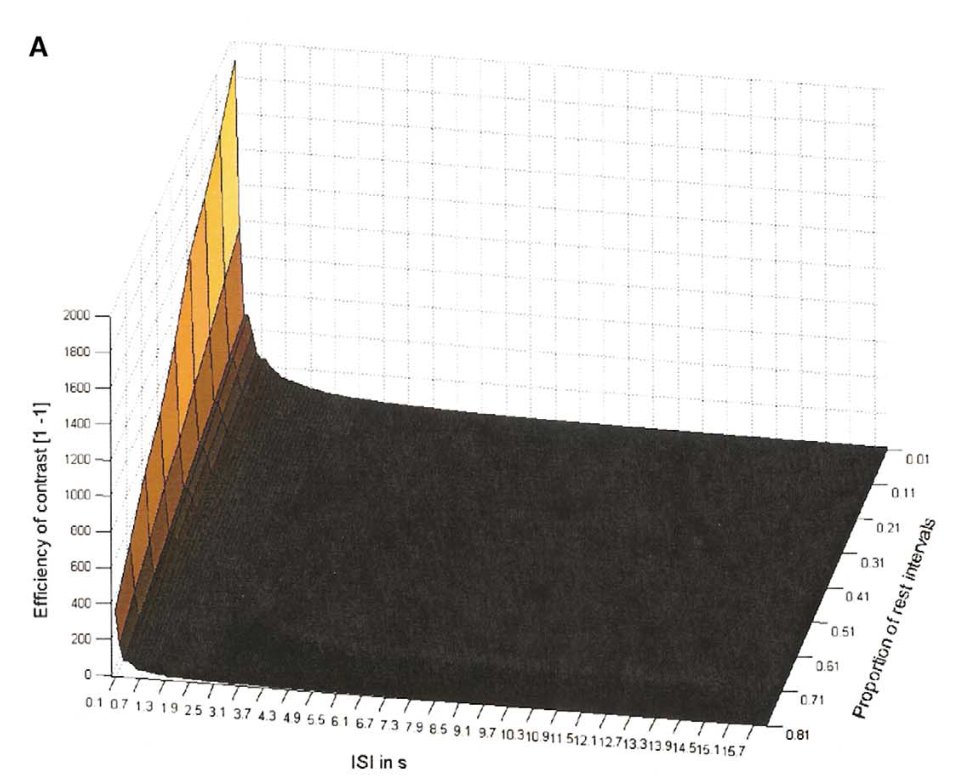
Contrast efficiency as a function of inter-stimulus interval
Contrast efficiency as a function of inter-stimulus interval. Lecture 3.1 slides (Wager)
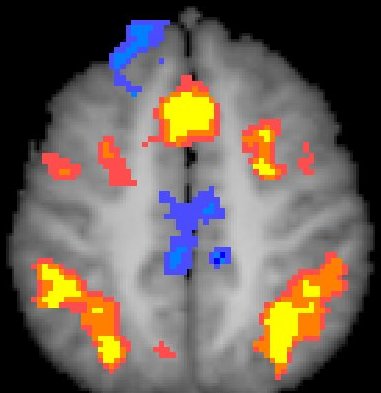
Axial activation map from a well-powered task contrast
Axial activation map from a well-powered task contrast. Lecture 3.1 slides (Wager)

03Algebraic foundations: design efficiency

  • Power depends on effect magnitude (c'beta-hat) divided by its standard error; the error term contains c'(X'X)^-1 c times sigma-squared.
  • The (X'X)^-1 term depends only on the design, not the data, so efficiency can be computed before scanning.
  • Efficient designs maximize predictor variance and minimize covariance among predictors (orthogonal predictors).
  • Maximizing average efficiency across the contrasts you care about is called A-optimality; D-optimality is another criterion.
  • The fMRI formula adds contrasts (C), the high-pass filter matrix (K, giving filtered design Z) and the autocorrelation matrix (V).
  • Rules of thumb: equal trial counts, large manipulations at the extremes, few event types, and a large psychological effect.

04Temporal frequencies, block length and filtering

  • A single brief event is inefficient; very slow designs are hard to distinguish from the intercept and mean scanner drift.
  • For one predictor and a correct HRF, a sine wave near 1/33 s per cycle is close to optimal.
  • Short blocks lose variance because the HRF acts as a smoothing filter; long blocks overlap with 1/f noise.
  • High-pass filtering removes variance from both noise and predictors, so its optimal cutoff depends on stimulation frequency, noise and HRF.
  • Example: 18 s blocks with an 80 s filter retain design variance; blocks over 40 s are risky.

05Eight principles of fMRI design

  • Sample size is usually the rate-limiting factor; group power is bounded by subjects even if first-level efficiency were infinite.
  • Scan time: first-level efficiency grows with the square root of images; rule of thumb is 20 to 40 min functional time, then add participants.
  • Number of conditions: two (task minus control) is optimal for detection; more comparison conditions help interpretability.
  • Grouping: blocks give detection power and robustness; event-related designs give more specific inferences.
  • Randomization: randomize per participant and jitter or use catch trials, because fixed A-then-B ordering produces spurious A > B differences.
  • Nonlinearity: BOLD saturates at short ISIs (about 10 percent at 5 s, strong at 1 s); space events at least 3 to 4 s apart.

06Dependent events and computer-aided optimization

  • With a fixed 20 s ISI, regressors for temporally dependent events correlate up to r = 0.93 under a flexible FIR model.
  • Jitter plus catch trials (partial trials on half the trials) reduce the maximum correlation to about r = 0.47.
  • Fundamental tradeoff: blocks detect condition differences best; unpredictable sequences (m-sequences) estimate HRF shape best.
  • Tools: the genetic algorithm (Wager and Nichols 2003), OptSeq (Greve) and m-sequence programs (Buracas) optimize trial order.
  • The genetic algorithm handles multiple weighted contrasts, filtering, autocorrelation, a simple nonlinearity model and counterbalancing.
  • A favored scheme: event-related, pseudorandomized by genetic algorithm, balancing contrast and HRF power, with at least 4 s between events.
Resting-state networks matched to BrainMap task networks — Lecture 3.5 slides (Calhoun)

From the instructors' research

Related figures

Examples of these concepts in published work by the course instructors.

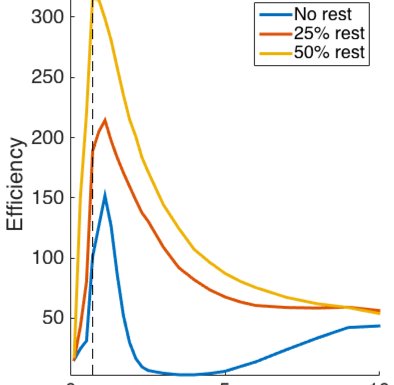
Design efficiency as a function of ISI and rest proportion
Design efficiency as a function of ISI and rest proportion. Wager & Nichols (2003), NeuroImage