Day 2 · Modeling, connectivity, and ICA

Day 2Session 2.6Calhoun0:15 hLecture

Derivative boost

A short session on hemodynamic delays that vary across the brain, why adding a temporal derivative to the HRF only partly solves the problem, and how a 'boosted' amplitude estimate combining the HRF and derivative parameters removes latency-induced amplitude bias in group (random-effects) analyses.

Take-aways

  • Hemodynamic delays vary by several seconds across the brain and bias amplitude estimates if ignored.
  • Adding an HRF derivative fits delays of about plus or minus 2 s but does not fix group-level bias on its own.
  • Combine the HRF and derivative parameters into a boosted contrast image before taking results to a random-effects analysis.

Key terms

  • spatially varying delay
  • slice-timing correction
  • temporal derivative
  • latency-induced amplitude bias
  • derivative boost
  • fixed vs. random effects
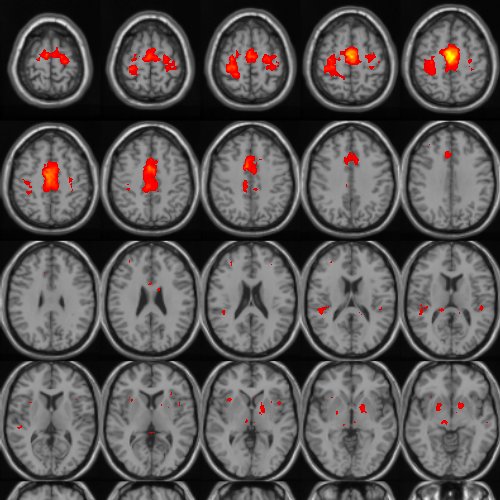
Activation gained by adding the temporal derivative term
Activation gained by adding the temporal derivative term. Lecture 2.6 slides (Calhoun)

Outline

What the session covers

01Spatially varying delays

  • Scan-related delays (up to half the TR) can be removed with slice-timing correction.
  • Brain-related delays of up to 4-5 s cannot be corrected at acquisition; we are stuck with them.
  • Ignoring delays biases the model toward regions whose response happens to match the assumed timing.
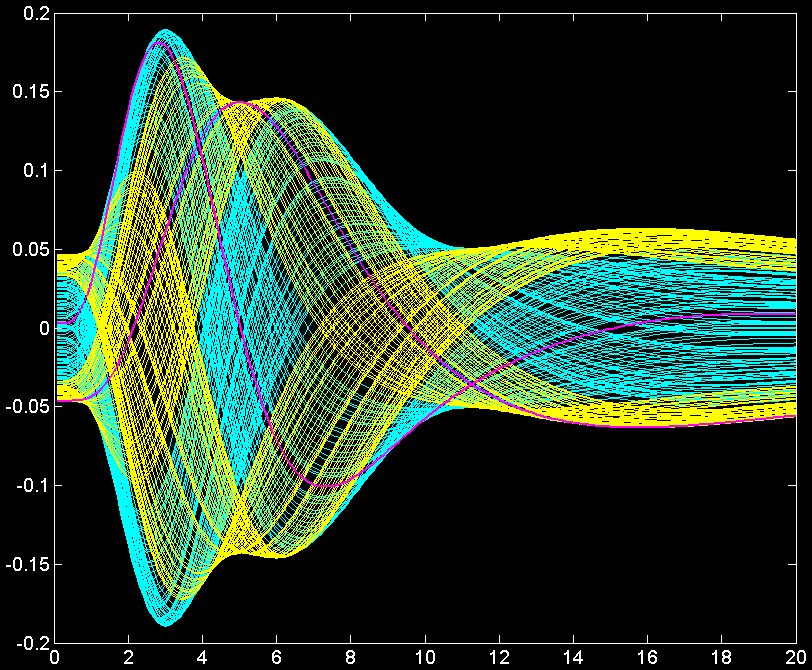
  • More flexible models (basis functions, FIR) handle delays; the simplest option is adding a derivative term to the HRF.
  • The derivative term allows the model to fit delays on the order of plus or minus 2 s.
02The derivative boost

  • Caveat: the derivative helps a fixed-effects analysis (absorbing variance, increasing significance) but a random-effects analysis remains biased if only the HRF beta is used.
  • Solution: compute a modified (boosted) contrast image using parameters from both the HRF and its derivative (Calhoun, Stevens, Pearlson and Kiehl, NeuroImage 2004).
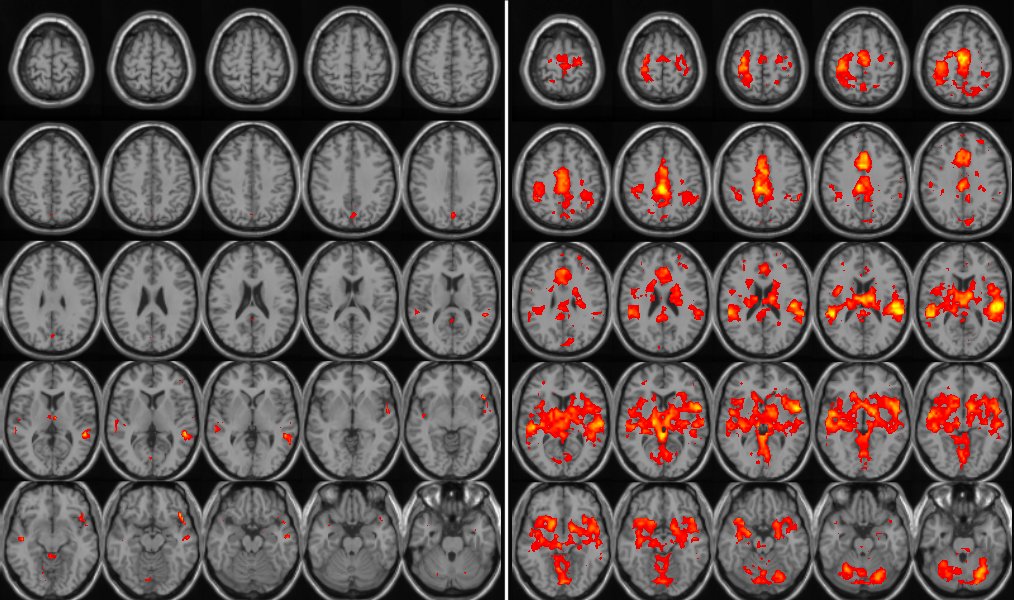
  • Auditory oddball example: maps of (with derivative) minus (without derivative) for target and novel stimuli show where amplitude was underestimated.
  • The target-minus-novel comparison identifies regions exhibiting significant amplitude bias.
  • Related work estimates delay in functional network connectivity via dynamic coherence analysis (Yaesoubi et al. 2015).
Family of hemodynamic responses spanning delay and dispersion
Family of hemodynamic responses spanning delay and dispersion. Lecture 2.6 slides (Calhoun)
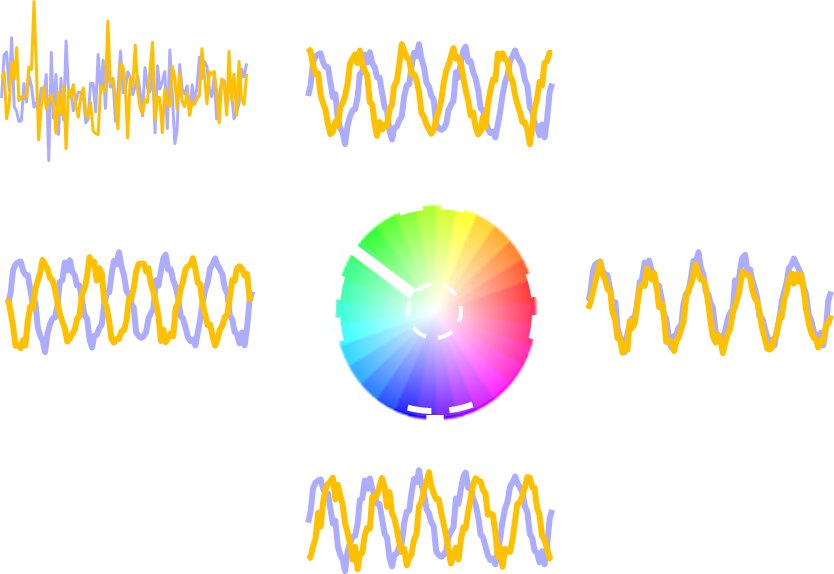
Phase-shifted oscillations and the derivative-boost phase wheel
Phase-shifted oscillations and the derivative-boost phase wheel. Lecture 2.6 slides (Calhoun)
ICA component maps with time courses on brain slices — Lecture 2.10 slides (Calhoun)
Axial montage of derivative-boosted t statistics
Axial montage of derivative-boosted t statistics. Lecture 2.6 slides (Calhoun)