Day 2 · Modeling, connectivity, and ICA

Day 2Session 2.7Wager0:15 hLecture

Parametric modulators

This session introduces parametric modulation, which models trial-to-trial variation in brain activity as a function of a behavioral or stimulus variable within a person. It explains how SPM constructs and orthogonalizes modulator regressors, the assumptions involved, and why modulating duration rather than amplitude matters when reaction time varies.

Take-aways

  • Parametric modulators test within-person relationships between a trial-level variable and brain activity, beyond the average response.
  • SPM orthogonalizes modulators sequentially; their order and interval scaling determine what each regressor can explain.
  • When reaction time varies, modulating duration (variable epochs) controls for RT better than modulating amplitude.

Key terms

  • parametric modulator
  • standard regressor
  • orthogonalization (spm_orth)
  • time modulation
  • amplitude vs. duration modulation
  • variable-epoch model
  • reaction time confound
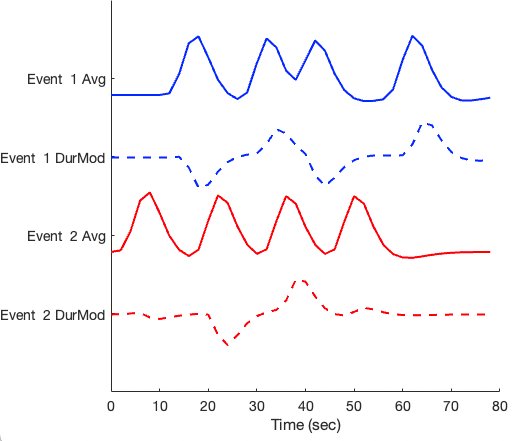
Variable-duration and constant-impulse models after HRF convolution
Variable-duration and constant-impulse models after HRF convolution. Lecture 2.7 slides (Wager)

Outline

What the session covers

01Why parametric modulation

  • Captures brain-behavior relationships across trials within a person, with enhanced psychological specificity.
  • Modeling activity as a function of performance across multiple levels can give stronger evidence than a contrast between two conditions.
  • Examples: Tower of London task complexity, goal (purchase) value in ventromedial PFC (Dagher 1999; Hare 2009; Grinband 2006; Wood 2008).
  • Convolution assumptions still apply: the neural activity function, the HRF, and linear time-invariance are assumed correct.
02How modulators work in SPM

  • The standard regressor captures the average event-related response.
  • The modulator is orthogonal to the standard regressor, so it captures activity related to the variable above and beyond the average response.
  • Assumptions: brain responses are linear in the input variable and sensitive to its interval scaling; only stick-function amplitude is modulated, not shape or duration.
  • Multiple modulators are orthogonalized sequentially with respect to earlier ones (spm_orth.m), so order matters and later modulators explain only leftover variance.
  • SPM adds a modulator regressor after each event regressor; time modulation adds a regressor for linear change within the session.
  • With basis functions, SPM adds one regressor per basis function per modulator, including time.
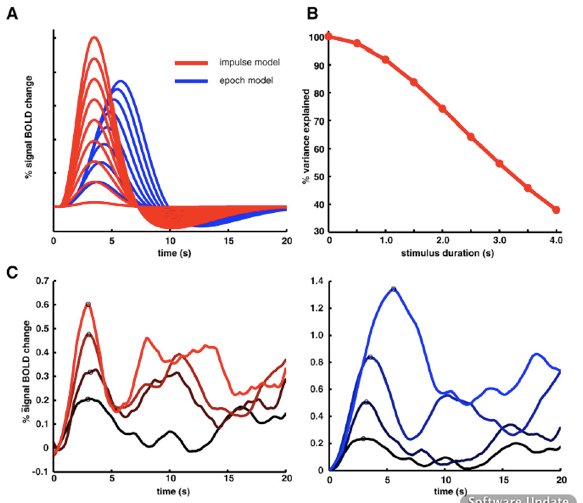
Impulse versus epoch models across stimulus durations
Impulse versus epoch models across stimulus durations. Lecture 2.7 slides (Wager)
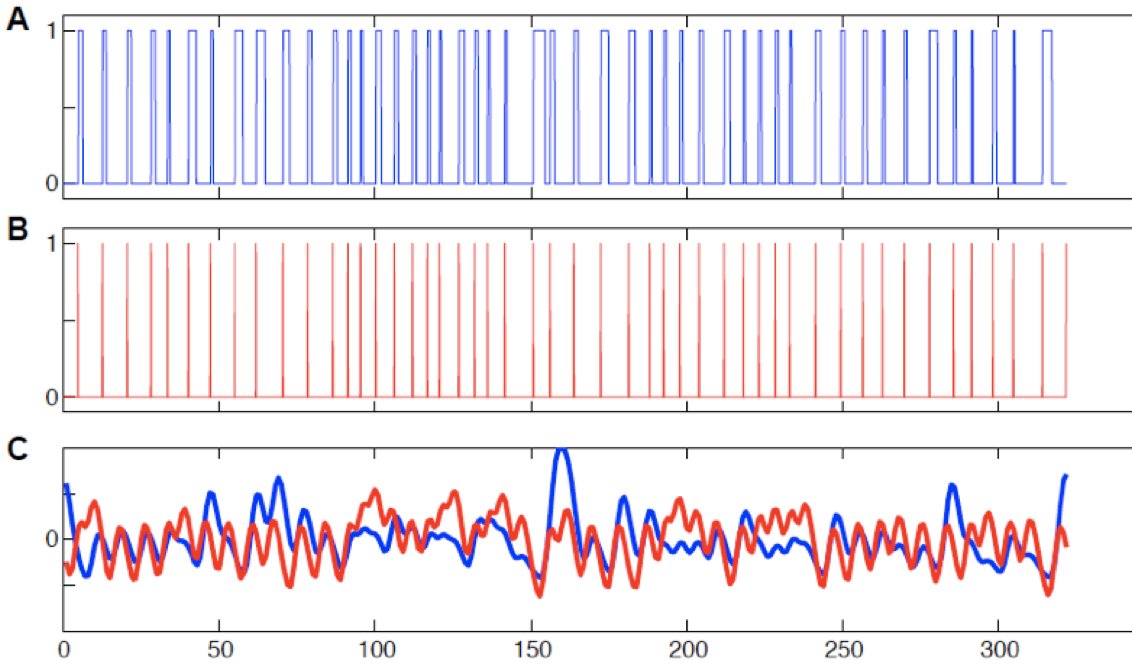
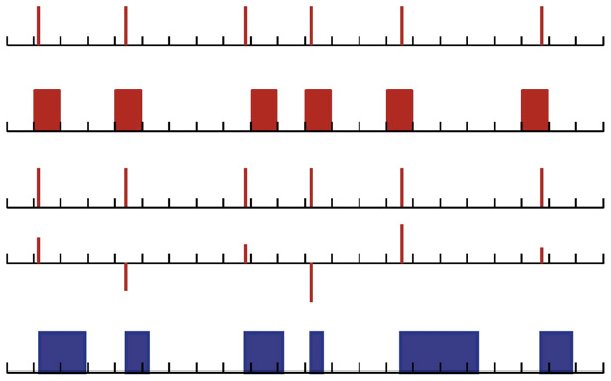
Impulse and epoch event-coding schemes over time
Impulse and epoch event-coding schemes over time. Lecture 2.7 slides (Wager)

03Amplitude versus duration, and reaction time as a confound

  • Events versus epochs matters for event-related fMRI (Grinband et al. 2008); in visual cortex, contrast modulation and duration modulation give different fits.
  • Four RT models: standard, amplitude modulated by RT, RT nuisance regressor, and duration modulated by RT (variable-duration model).
  • The standard model confounds duration differences with magnitude differences, at both within-subject and group levels.
  • The variable-duration model (Model 4) best controls for RT in a within-person ANCOVA design; models 3 and 4 diverge as RTs get longer.
  • The variable-epoch model has no standard regressor; to test effects above and beyond the average response, build both and orthogonalize the second to the first.
  • CANlab Core tools can build such custom regressors for import into SPM; example code is at canlab.github.io/tutorials.
Colored white-matter fiber tract renderings from multiple views — Lecture 2.9 slides (Wager)
Design matrix with duration-modulated parametric regressors
Design matrix with duration-modulated parametric regressors. Lecture 2.7 slides (Wager)

From the instructors' research

Related figures

Examples of these concepts in published work by the course instructors.

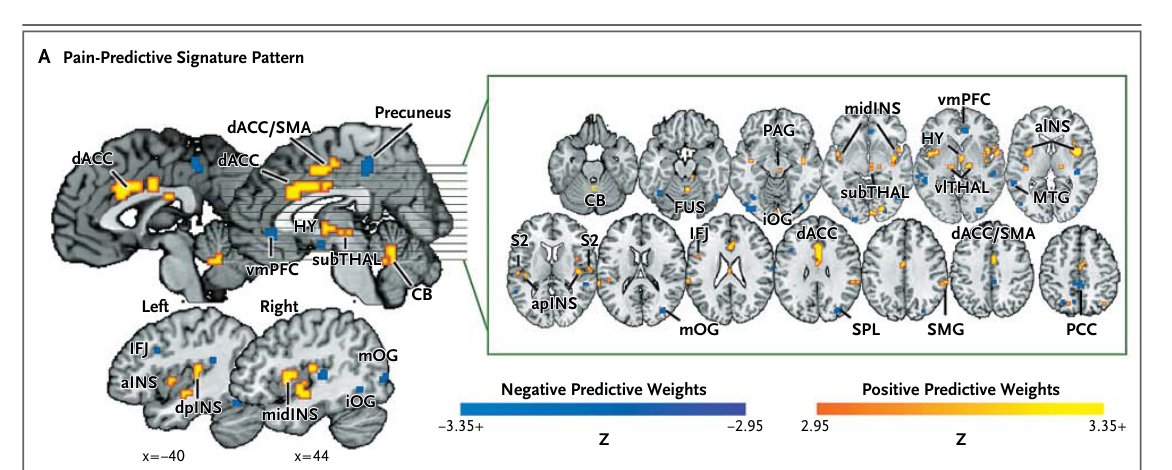
Neurologic Pain Signature predictive weight map
Neurologic Pain Signature predictive weight map. Wager et al. (2013), New England Journal of Medicine
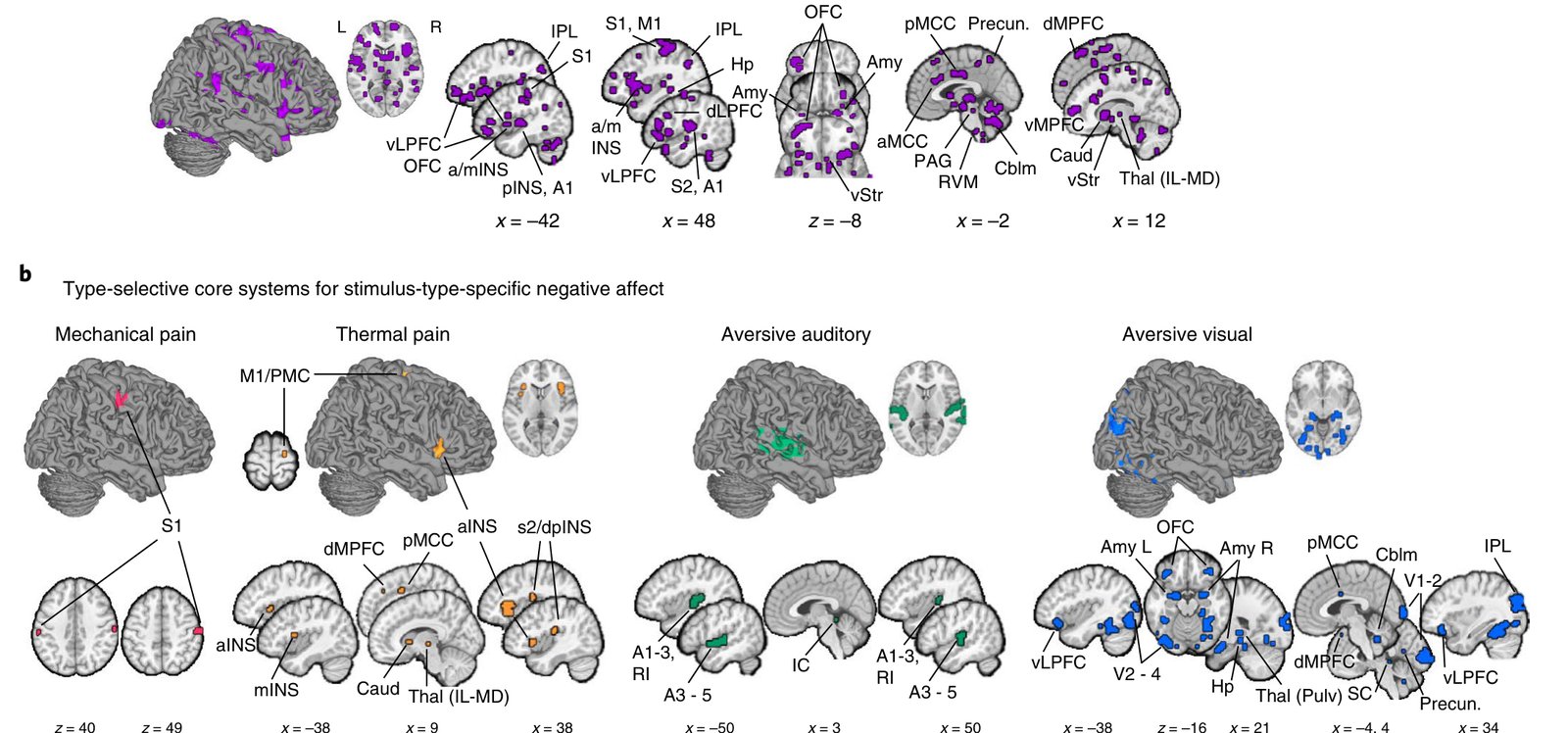
Common and stimulus-specific negative affect representations across the brain
Common and stimulus-specific negative affect representations across the brain. Čeko et al. (2022), Nature Neuroscience